 Is concierge medicine worth it? The short answer is yes, if you’re a patient interested in being an active participant in your own healthcare. While concierge medicine does involve out-of-pocket expense, it delivers solid value in the form of time with your doctor and individualized care. For those who view health as a priority, it can be an excellent investment.
Is concierge medicine worth it? It’s a good question, and one I sometimes get when I explain membership medicine to someone who’s unfamiliar with the model.
For some, the term “concierge medicine” conjures up a particular picture. Luxury. A doctor on call for your every whim. Something reserved for the wealthy.
This picture is not accurate. In reality, “concierge medicine” simply means “individualized care.”
Let me unpack what that actually looks like, and why I believe it’s worth it, both for my patients and for me.

Doctor’s Appointments in Conventional Care
Most healthcare visits in the conventional system start the same way. First, you get scheduled based on a chief complaint.
What’s going on today? Why do you need to be seen?
That question matters, but answering it well takes time, background, and context that a short visit simply doesn’t allow for.
A physician needs to understand a patient’s lifestyle, history, and circumstances to get to the real concern beneath the surface complaint. And, unfortunately, the conventional system doesn’t build this into patient care.
Instead, if an issue requires deeper investigation, patients are often referred to a specialist. But that specialist typically suffers from the same problem. They don’t yet know the patient, and they don’t have time to know the patient. Further, they’re only looking at the one organ system of their specialty.
The whole picture never comes together.
Appointments in Concierge Medicine
In my practice, I ask patients to write down every concern they have before their visit. Every single one.
If someone brings me 12 concerns, I can usually organize them into three main categories with related sub-issues, then consider all of it in one encounter. Whatever we can’t get to that day, we prioritize and return to at the next visit.
This isn’t a one-and-done transaction. It’s a relationship that builds over time, which is why our memberships run in one-year increments.
Concierge medicine also gives me the ability to coordinate care across specialists. Most specialists aren’t conferring with each other, and important overlaps can be missed as a result.
As the primary care physician, it’s my job to put the whole picture together. And as a concierge physician, I have the time and freedom baked in to do so. When needed, I can then intervene on a patient’s behalf in a way they often can’t for themselves.
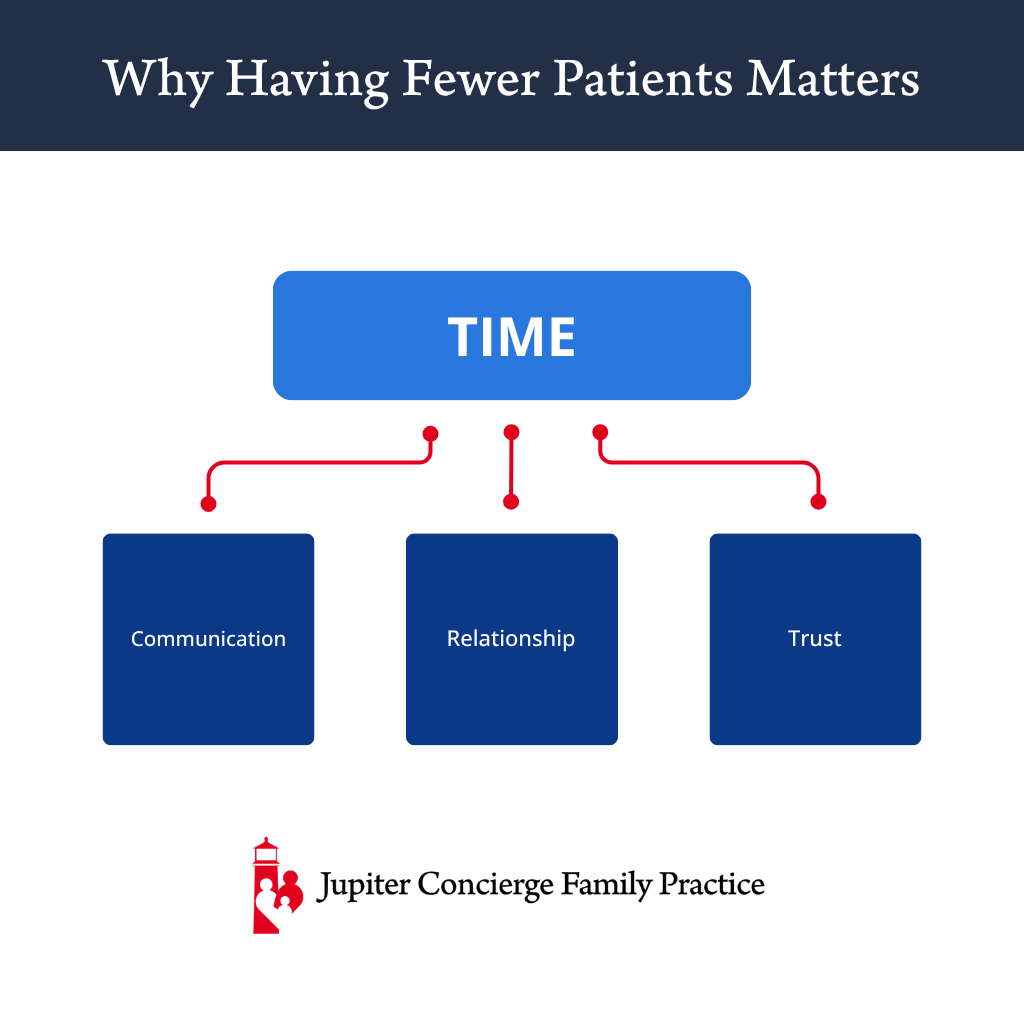
Why Having Fewer Patients Matters
Communication is the foundation of every physician-patient relationship. And communication is complicated, as most married folks know. It’s not just about the words themselves, but the pace, the pauses, the emphasis on the speaker’s side, along with how much the listener can actually absorb in the moment.
The faster the information gets delivered, the less it is truly understood.
In conventional care, physicians often see 25–30 patients a day, not because they want to, but because they’re required to. This setup does not facilitate productive communication.
True concierge medicine builds time into appointments and prioritizes understanding. In our practice, for example, a standard office visit runs a minimum of 30 minutes. Complex visits run 45 to 60 minutes, and a preventative annual physical gets a full 90 minutes. Even then, I sometimes want more time with patients.
All that time creates something conventional visits rarely support: a real relationship. The most complex patient I have, after several years together, can become one of my simplest patients to care for. We know each other. We’re caught up. There’s history behind every conversation.
The “Luxury” Misconception
Concierge medicine is not “luxurious.” Yes, some practices may fall into a more “high-end” category, but what we do as concierge physicians is what should ideally be the standard for all medical care.
Let’s take a basic, seemingly superficial element, for example: office design.
Walking into a doctor’s office often feels similar to seeing flashing lights in your rearview mirror. Your heart rate jumps, though you’ve done nothing wrong. You’re anxious before you even speak with anyone. Interactions feel combative rather than reassuring.
In an effort to remove that layer of anxiety, I’ve designed my office to be comfortable and welcoming. Not luxurious, but warm and calm. And I’ve set high standards regarding patient interactions for all of my staff.
None of this is luxury. It’s baseline.
Further, there’s the “luxury” of time itself, which I’ve already mentioned is the greatest resource in concierge medicine. It’s the foundation for building relationships and trust. Again, this should really be a baseline in medical care.
Finally, we have the financial aspect. This is perhaps the component that causes some to view concierge medicine as a luxury. We’ve been so conditioned by the conventional system to view insurance as the only method of paying for our care that any out-of-pocket expense seems excessive.
So the question is, is concierge medicine worth it financially?
Let me ask you this: Is your car worth it? Was your last vacation worth it? I don’t mean these questions facetiously. Transportation and recreation are important parts of life. If you can afford a comfortable car or enjoyable vacation, there’s absolutely nothing wrong with that.
The truth is that people spend more on cars, vacations, and even eating out than on an annual concierge medicine membership. The real question, then, is one of priority. Do we value our health the way we value a good vacation?
I take my patients’ financial investment in their health seriously. My goal at the end of every year is for each person to look back and say, “I got more out of that than I expected.” I want them to feel that, beyond doubt, their membership was worth it. Our renewal rate sits around 95%, which tells me that goal is being met.
Who Is Concierge Medicine Not For?
Concierge medicine isn’t the right fit for everyone.
First, it’s not for someone who wants healthcare “done for” them, without their participation. My practice requires patients to be active partners in their own care.
Further, if a patient is unwilling to change certain harmful behaviors (illicit drug use, for example), the relationship won’t benefit them anyway. If they’re willing to make a sincere effort at change, of course, that’s a different story.
Finally, both doctor and patient need aligned expectations. I interview every prospective patient before they join our practice to understand their needs and wishes. If an expectation falls outside my comfort or expertise, I tell them directly. There may be another physician better suited to help.
Searching for Concierge Medicine? One Question Worth Asking
If you’re considering a concierge practice, whether mine or another one, I have one question I’d suggest asking directly: “What do you see as the biggest value in me joining your practice, as it relates to me?”
That question requires the physician to listen to you. It requires them to have been paying attention to what matters to you, or to stop and ask.
If they respond by talking about why their practice is valuable in general terms, that’s not addressing the question you asked. Individualized care means the answer should be about your motivation, not theirs.
Every patient has a “why.” Maybe it’s wanting to see grandchildren graduate from college. Maybe it’s a fear of developing Parkinson’s like Granddad. Once I know that motivation, I use it as the entry point for helping someone make progress in their health.
So, Is Concierge Medicine Worth It?
For patients who want to be true participants in their own care, who value time and communication as much as expertise, and who are ready for a real relationship with their physician, true concierge medicine delivers exactly that.
If you’re curious whether this model fits your life, I’d encourage you to learn more about our team or explore what a membership at Jupiter looks like.