Have you ever arrived at a doctor’s office expecting to see the physician, only to be seen by a nurse practitioner instead? If so, you might have wondered: Is this a step down? Am I getting the care I need?
I hear this concern occasionally, and I understand it. But the truth is, nurse practitioners (also known as advanced practice registered nurses, or APRNs) fill an important role in healthcare, one that I believe brings a great deal of value to practices and patients alike. As such, my team at Jupiter Concierge Family Practice includes both me as the physician and Brittany Johnston, our APRN.
So let’s take a look at APRNs vs. physicians, what each of us brings to the table, and why this combination provides better care than either of us could deliver alone.

APRN vs. Physician Qualifications
If we want to know what’s the difference between a nurse practitioner and a doctor, we have to start with their training.
An APRN like Brittany completes a four-year nursing degree, practices as a nurse, and then earns a Master of Science in Nursing (MSN). In her case, Brittany holds an MSN and is a board-certified Family Nurse Practitioner (FNP-C).
A physician follows a different path: a four-year undergraduate degree, four years of medical school, and at least three years of a residency program. Some physicians pursue additional fellowship training for subspecialties after that.
In total, the hours of training on a physician’s path far outstrip those on a nurse practitioner’s path. That difference matters in specific clinical contexts, which I’ll discuss below.
APRN vs. Physician: Differences in Practice
That was education and training. But what’s the difference between a doctor and a nurse practitioner in everyday practice?
The APRN vs. physician distinction plays out in practical ways on our team here at Jupiter. For instance, about 80% of what I do as a physician can be handled very well by an APRN. Most patients who come through our door have straightforward presentations, and Brittany is thoroughly equipped to evaluate and treat them.
However, the distinction sharpens in more complex cases. When a patient’s presentation is unusual, when standard treatment plans aren’t producing the expected results, or when I suspect an underlying cause that isn’t readily apparent, that’s where my additional training and clinical experience become most relevant. That minority of patients, perhaps 10–20%, where things aren’t what they typically appear to be, requires a deeper level of diagnostic inquiry from the physician.
Legal considerations also come into play with APRNs vs. physicians. In Florida, for instance, nurse practitioners have been granted the ability to practice independently. Other states require APRNs to practice under a physician.
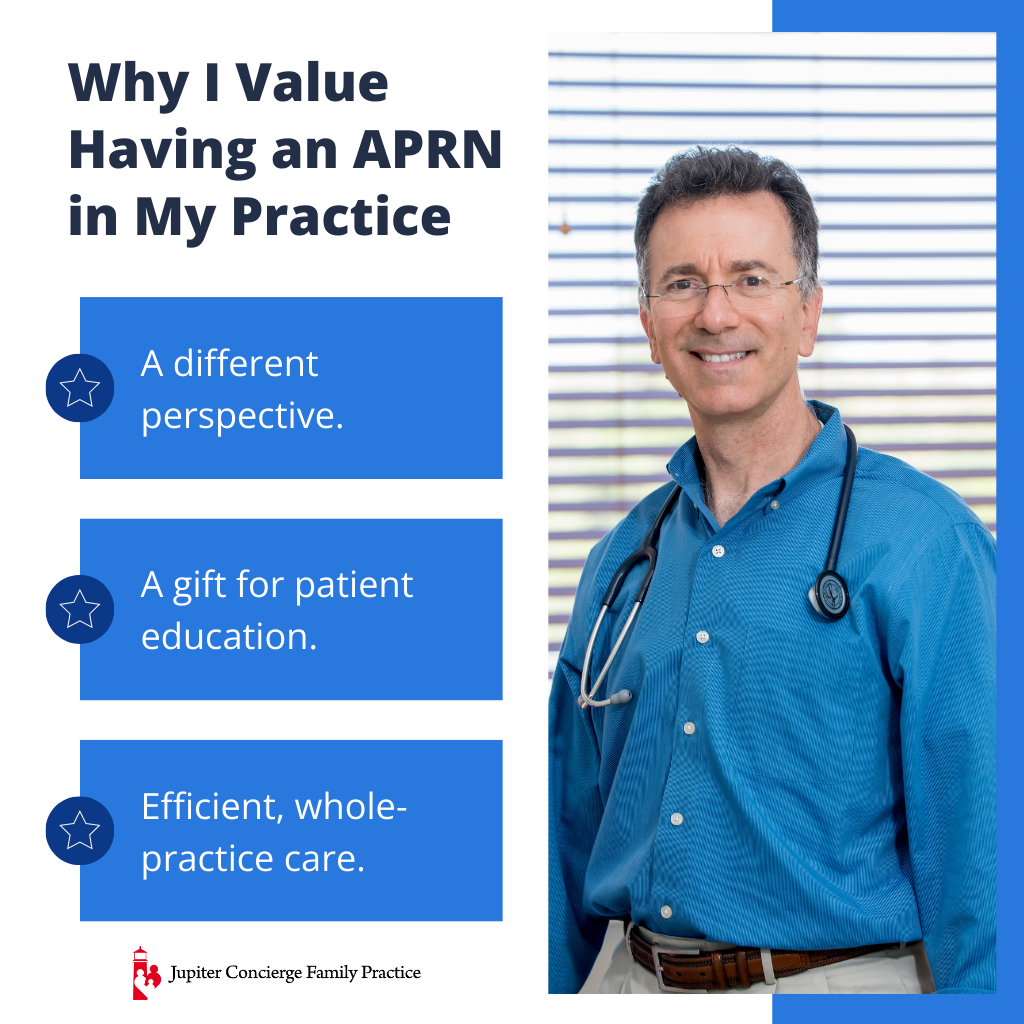
Why I Value Having an APRN in My Practice
When people ask me why I hired an APRN vs. another physician, I want them to see the genuine asset nurse practitioners can be. Adding additional physicians expands capacity, of course, which is excellent. But having an APRN offers a different set of benefits:
A different perspective. In our practice, I review every patient Brittany sees, and we sometimes alternate seeing the same patients. If I have questions about her assessment of someone, we discuss it. Sometimes her perspective explains something I hadn’t fully considered. Other times, I offer a different angle that prompts a follow-up call or visit.
That collaborative review with a clinician trained in slightly different approaches and perspectives provides a built-in quality check that benefits every patient.
A gift for patient education. Nursing training places significant emphasis on teaching, a skill set that medical school and residency don’t prioritize in the same way. Brittany has a true ability to communicate health concepts to patients clearly and actionably. For our patients, that translates into better understanding of their conditions and better follow-through on their care plans.
Efficient, whole-practice care. Because Brittany handles routine prevention and straightforward cases so well, I remain available for patients who need more acute or complex attention. If someone calls with sudden abdominal pain or a spike in blood pressure, we can typically get them in within a few hours. That kind of scheduling agility is part of what makes concierge medicine work the way it should.
Additionally, having an APRN frees up my energy to investigate less common presentations. In other words, I have the time and bandwidth to identify zebras, not just horses.
Chronic Disease Management: APRN vs. Physician
One of the clearest illustrations of how the APRN vs. physician roles complement each other shows up in chronic disease management, whether a patient is dealing with diabetes, asthma, osteoarthritis, Parkinson’s, or another illness.
Managing a chronic condition involves two distinct components:
- Lifestyle and Education: Helping patients understand their condition, make behavioral changes, and build sustainable habits.
- Complex Disease Management: Navigating medication interactions, adjusting protocols as the disease progresses, weighing the risks and benefits of various treatments, and knowing when to scale back.
As an APRN, Brittany excels in the lifestyle and education aspect. Her training and approach are ideally suited to this kind of ongoing patient education and support.
As a physician, I take on the complex disease management side in its various aspects. For instance, the hardest decision is sometimes to do less. Knowing when the risks of a treatment or test outweigh its benefits requires experience and judgment that comes with time, which is where the physician role is critical.
APRN vs. Physician: Final Thoughts
Understanding the APRN vs. physician dynamic isn’t about ranking one role above the other. Both roles carry distinct value, and both are essential to delivering the kind of thorough, responsive care our patients deserve.
What sets our practice apart isn’t simply that we have an APRN on staff. It’s that Brittany and I function as genuine colleagues and collaborators, each contributing our strengths while keeping the patient’s best outcomes at the center of every decision.
That’s the standard we hold ourselves to, and it’s how every member of our practice gets the benefit of both perspectives for their care.