
Brain fog is one of the most common complaints I hear from patients. They come in describing a kind of mental cloudiness: They can’t recall names as quickly as before, they lose their train of thought, they feel like they’re not firing on all cylinders. The term is apt. You feel like you can’t find your way through your own mind.
If you’ve been experiencing this, you’re not alone. And more importantly, you don’t have to accept it.
Let’s discuss what brain fog is, what causes brain fog, and the steps you and your doctor can take toward getting real answers.
What Is Brain Fog?
What is brain fog? Simply put, it’s the feeling that you’re not thinking as sharply as you normally do. Maybe you can’t remember someone’s name, and then it comes to you a minute later. Maybe you forgot what you had for breakfast, or you find yourself losing track of conversations.
Brain fog can be subtle, sometimes first noticed by a spouse or close friend before the person themselves puts a name to it.
Here’s what I want you to know right away: Brain fog is common, but it’s not normal. It’s a symptom. And like all symptoms, it deserves proper attention.
What Causes Brain Fog? More Than You Might Think
When patients bring up brain fog as a concern, the elephant in the room is always Alzheimer’s disease or dementia. That’s understandable, and it needs to be addressed.
But for the great majority of people I see, Alzheimer’s is not what’s going on.
More often, what causes brain fog is far more common and far more treatable. Let me walk through the possibilities.
Conventional Causes of Brain Fog
Brain fog can stem from many causes, which is part of what makes this symptom tricky. To address it effectively, we have to get to the root cause. But many potential root causes exist. Conventional possibilities include:
- Significant situational stress
- Mental health conditions, like depression or anxiety
- Chronic illness
- Medication side effects or interactions
- Thyroid dysfunction
- Electrolyte imbalance
- Sleep apnea
That last one is worth pausing on.
Sleep apnea is extremely common and frequently overlooked. When you stop breathing for 10 or 15 seconds at a time throughout the night, your brain is repeatedly deprived of oxygen. Your body can’t do its crucial repair work while you sleep, resulting in a brain that’s working against a deficit every single morning.
When Conventional Causes Aren’t the Answer
Once we’ve ruled out the conventional culprits, the functional medicine approach becomes critically important.
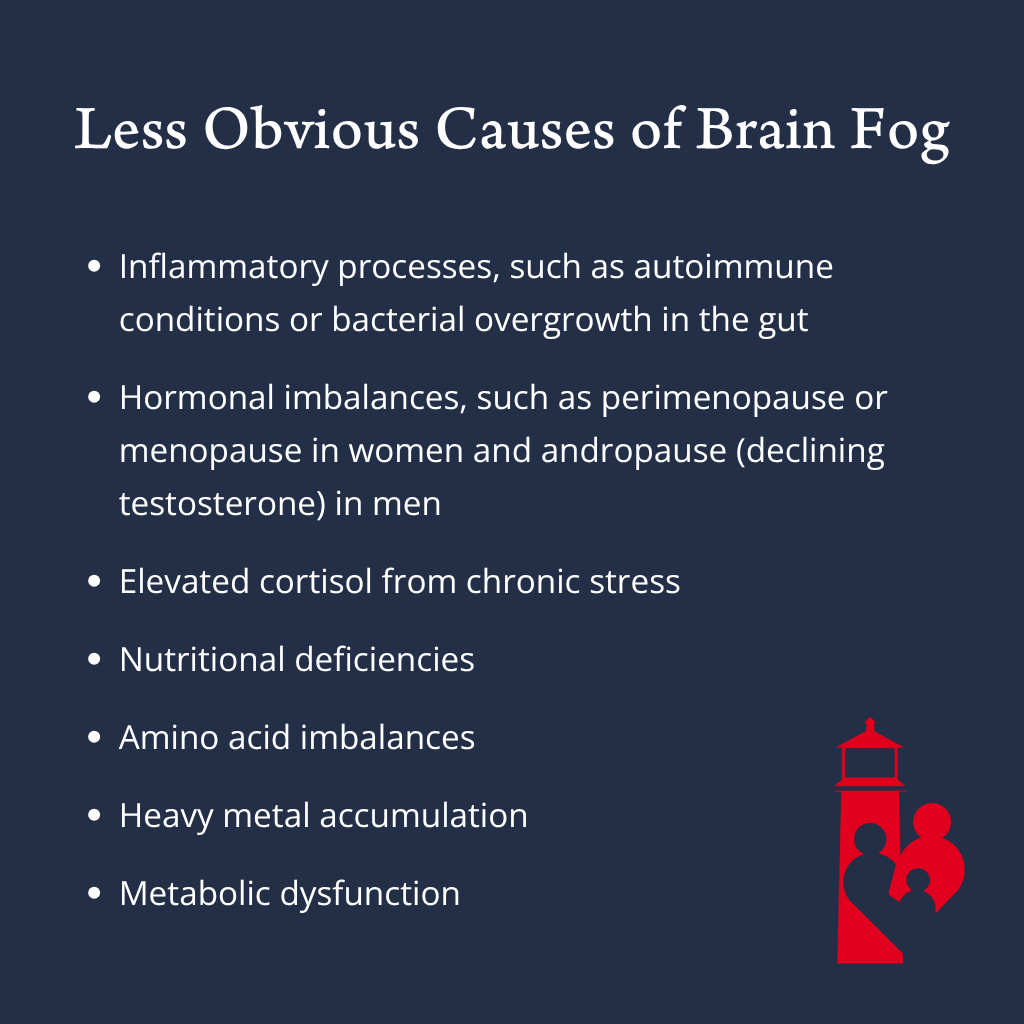
In my experience, the majority of brain fog cases come down to underlying imbalances that standard, conventional testing simply doesn’t look for. These include:
- Inflammatory processes, such as autoimmune conditions or bacterial overgrowth in the gut
- Hormonal imbalances, such as perimenopause or menopause in women and andropause (declining testosterone) in men
- Elevated cortisol from chronic stress
- Nutritional deficiencies
- Amino acid imbalances
- Heavy metal accumulation
- Metabolic dysfunction
Though the conventional issues I mentioned previously are possible sources of brain fog, I’d suggest perhaps 80% of cases stem from lifestyle-related causes.
How I Get to Brain Fog’s Root Cause: History and Evaluation
When someone comes to me with brain fog, the most important thing I do first is listen.
I want to understand exactly what they mean by brain fog. Are they forgetting names that come back a moment later? Struggling to do math they used to handle easily? Forgetting friends or family members? The degree and nature of the symptom tells me a great deal.
Having a family member or close friend present at the appointment can be extremely helpful, as the patient might not always be aware of subtle changes in themselves.
From there, I follow a structured process:
- Montreal Cognitive Assessment (MoCA): This standardized 30-point test gives me an objective baseline of cognitive function, letting me know how urgently to act and in what direction.
- Conventional workup: Blood work to check thyroid function, electrolytes, and other standard markers. A review of current medications. A detailed family history. If I have any suspicion of a serious neurological process, I may refer to a neurologist or order neuropsychological testing, which is a more intensive evaluation than the MoCA.
- Sleep study: Sleep apnea is common enough that it gets its own dedicated step for those with potential indicators.
- Functional medicine testing: Once conventional causes are addressed and the patient’s main concerns have been acknowledged and explored, we go deeper. I use functional medicine testing like stool analysis, salivary cortisol panels, and what I call an ION (Individual Optimal Nutrition) profile to look at how the body is functioning at a cellular and metabolic level. When we find abnormalities here and address them, patients frequently improve.
Making SENSE of Brain Fog
After evaluation, I most often find that lifestyle, or neglect of the Four Pillars of Health (Sleep, Exercise, Nutrition, and Stress Elimination), is in some way responsible for brain fog.
If you were hoping for a problem you could fix with a pill, that might be disappointing. But if you were hoping to address your brain fog naturally, without pharmaceuticals or serious interventions, this is good news. Let’s look at a relevant snapshot of each pillar:
- Sleep: Quality and quantity both matter. Sleep isn’t just rest; it’s when your brain literally cleans itself and repairs. Compromised sleep, whether from apnea or poor habits, leaves the brain running on empty.
- Exercise: Movement circulates blood and nutrients throughout the body, including to the brain. Even moderate, consistent exercise makes a measurable difference in cognitive clarity.
- Nutrition: If you’re eating processed foods, not enough protein, or too many refined carbohydrates, your blood might be circulating, but it isn’t bringing your brain the essential ingredients to function at its best.
- Stress Elimination: This isn’t eliminating the life stressors you can’t control, but rather the stressors you can do something about and have thus far chosen not to. Stimulants, for example, like excess caffeine, introduce unnecessary stress. Alcohol consumed daily, even in moderation, has a cumulative effect that often shows up as brain fog. Whether their origin is convenience, entertainment, or something else, optional stressors are a real hindrance to cognitive health.
A Word on Supplements
I understand why people reach for supplements when they’re struggling with brain fog. A quick search turns up dozens of products claiming to sharpen the mind, and many of the nutrients involved genuinely do support cognitive function.
As a physician practicing functional medicine, I’m a fan of strategic supplementation myself. But taking supplements without first understanding the root cause of an issue is what I’d call a shotgun approach. More often than not, it wastes emotional and financial energy without resolving the underlying problem. Some nutrients, taken in excess without proper evaluation, can actually create imbalances of their own.
Instead, the approach I suggest is to identify what’s actually deficient or dysregulated first, then supplement with intention.
What Causes Brain Fog: Final Thoughts
If you’ve been trying to figure out what causes brain fog and feel like you’ve hit a wall, I want to offer you encouragement. Brain fog is a legitimate symptom you shouldn’t ignore. It may not be serious, but it certainly affects your quality of life. And you can’t do anything about it unless you bring it up.
When seeing a doctor, your symptoms deserve a thorough evaluation, not a vague dismissal. I understand that in the conventional medical model, doctors might have a hard time with brain fog since it’s an imprecise symptom with many possible causes. But I’m not okay with a response of “there’s nothing else we can do.” Because in my experience, that’s almost never true.
No patient ever has a completely exhaustive workup and a perfect lifestyle. There’s almost always something that can be improved, investigated, or adjusted. If you’ve been told otherwise, it may be time to seek a second opinion and/or explore a functional medicine evaluation.
Now, if brain fog stems from something concrete and irreversible, like a significant head injury, the conversation shifts. In that case, the focus becomes, how do we work with the function you do have? Accommodations like sticky notes, routines, schedules, and structured habits can meaningfully reduce the daily burden of memory and cognitive difficulties.
But that’s a last resort. A world of possibilities exists between that extreme and doing nothing.