Peptide therapy is everywhere right now. Ads are popping up on streaming platforms, wellness websites, and social media feeds. Patients are coming in curious, excited, and sometimes already convinced they need it.
The promise is compelling. But before we talk about what peptide therapy can and can’t do, I want to make sure we’re starting in the right place.
What Is Peptide Therapy?
What is peptide therapy, exactly? To answer that, we first need to understand what a peptide is.
Peptides are short chains of amino acids, not quite large enough to be classified as proteins. They work by binding to specific receptors throughout the body, essentially sending signals that tell cells what to do: build tissue, regulate hormones, reduce inflammation, and more.
Peptide therapies have been around for about 100 years. The original peptide discovered was insulin, which has saved countless lives and dramatically improved quality of life for people with diabetes.
More recently, the most talked-about class of peptides has been GLP-1 agonists, such as semaglutide and tirzepatide. These were originally developed for diabetes management, but their significant effects on appetite suppression and weight loss quickly made them a cultural phenomenon. Since weight management has been a priority in medicine for decades, it’s no wonder GLP-1 drugs have taken center stage.
Other peptides have shown promise in areas like collagen production, muscle tissue repair, bone density, and joint health. The research pipeline is active and growing.
The Risks and Benefits of Peptide Therapy
The benefits of peptide therapy in legitimate clinical settings are real. When a peptide drug has gone through rigorous, double-blind, placebo-controlled research, we have valid information to act on. That’s the standard I hold any treatment to.
But here’s where things get complicated.
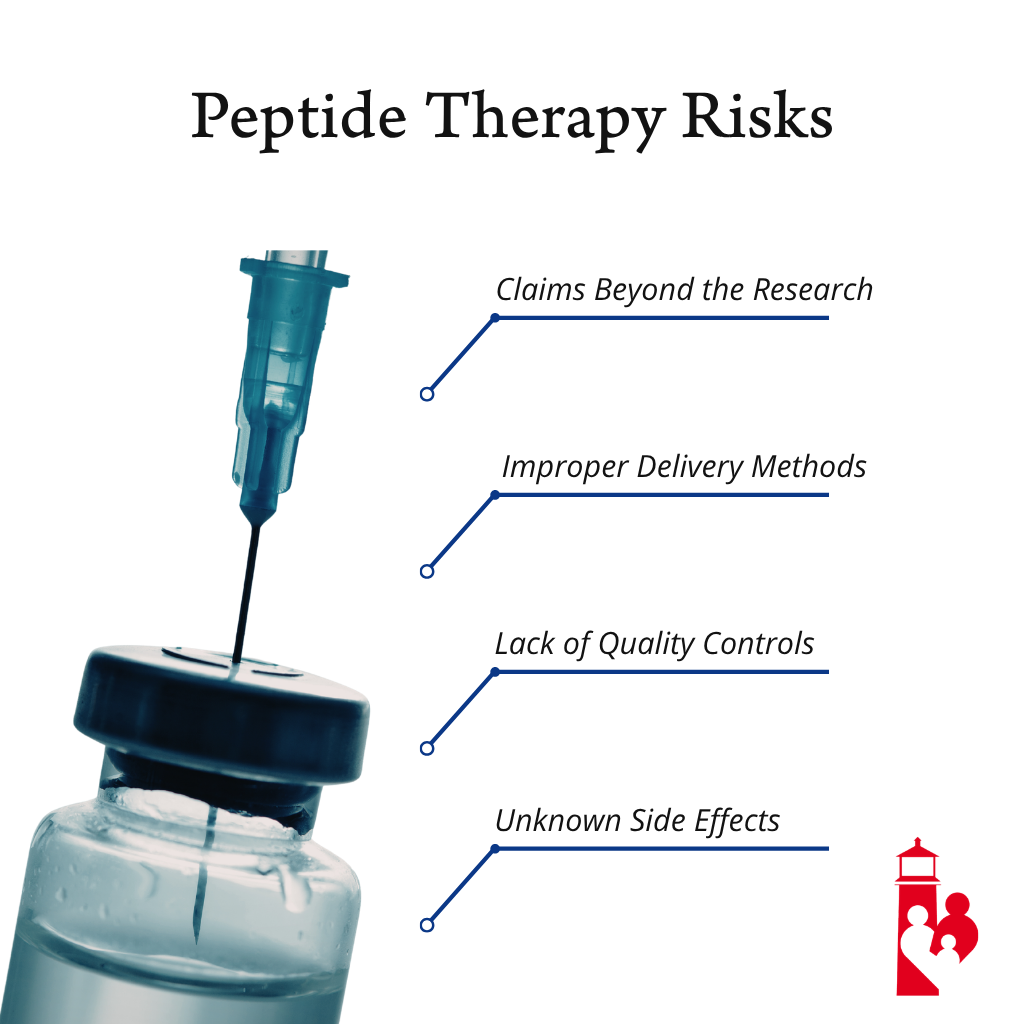
The number of peptide products on the market right now is probably 100 times greater than the research supporting them. Many products are sold online without medical oversight, and they’re often sold in forms that weren’t used in the original research.
The problem with taking a peptide by mouth, for example, when an injected form was actually studied, is that stomach acid tends to break the peptide down before it can do anything useful. The most effective delivery method for peptides is often injection because this route is the purest and bypasses potential degradation.
Beyond the delivery form, peptide therapies have a manufacturing problem. Products can be made without proper quality controls, leaving you with impurities, contaminated compounds, or molecules that simply don’t contain what they claim to.
Peptide therapies also have risks that aren’t obvious until you understand how peptides work.
Because peptide receptors aren’t limited to one location in the body, a peptide you take to target a problem in one area can still stimulate receptors elsewhere. Growth hormone peptides, for example, can be beneficial for certain conditions, but if someone has an undetected cancer, the same growth signals could accelerate its progression.
Insulin is a useful illustration here, too. Used appropriately, it’s life-saving. But when people take insulin before they truly need it, they develop resistance to the insulin over time, requiring more and more to achieve the same effect. Eventually, it can stop working altogether, which is a dangerous situation.
What to Do Before Exploring Peptide Therapy
I’d like to pivot here to what I believe is the most important part of the conversation: Even the best-researched peptide therapy has limits if your health foundation is unstable.
I’ve seen this play out with insulin for years. A patient manages their blood sugar with insulin, but continues to eat and sleep poorly, skip exercise, and carry chronic stress. Insulin can only do so much when daily habits allow inflammation to persist, cortisol to wreak havoc, and nightly rest and repair to fall by the wayside.
People are constantly searching for the next advancement in wellness, and that curiosity isn’t a bad thing. But I’ve noticed a pattern repeating itself throughout the history of medicine: Human beings look for shortcuts, and the hardest thing to do, the foundational thing, gets deprioritized.
My philosophy is that the hardest thing to do is usually the right thing. And the right thing, before any peptide or medication enters the picture, is to build what I call the Four Pillars of Health: Sleep, Exercise, Nutrition, and Stress Elimination.
These aren’t buzzwords or gimmicks. They’re pillars because they’ve stood the test of time.
This holds true even in the face of today’s most popular peptide therapy. I’ve had patients ask for GLP-1 drugs with no intention (initially) of making lifestyle changes, forcing a rather direct response from me: GLP-1 therapy alone is not appropriate as the sole approach to weight loss.
Why? Because when weight loss occurs due to an artificially suppressed appetite but not to any changes in nutrition or exercise, two negative outcomes occur. First, the patient loses not only fat but also muscle mass. Second, when they stop taking the drug, patients regain their weight, but without regaining their lost muscle.
The irony here is that greater muscle mass means the body burns more calories, even at rest. Losing muscle while losing weight makes future weight management harder, not easier.
When health fundamentals are neglected, no therapy, peptide or otherwise, can truly compensate. But when they’re prioritized, any treatment you pursue will work better. You’ll likely need less of it, and you’ll get more from it.

Nothing Replaces a Healthy Human Being
The body is a remarkable machine. And the truth is that nothing manmade comes close to replacing the benefit of proper care and maintenance of this incredible machine.
Sleep allows your DNA to reset and repair. Exercise builds the metabolic engine that makes everything else work better. Nutrition provides the raw materials for every cellular process. Stress elimination keeps cortisol from quietly dismantling the progress you’ve made everywhere else.
Yes, we have all kinds of tools, including peptide therapies, to support the body when something goes wrong. In extreme cases, we can even keep it alive artificially (for a time) as an organ is failing. But consider: The best solution for a failed organ is still a healthy human organ from a donor. Nothing engineered has come close to replicating it.
That truth scales down to everyday health.
When you prioritize the four pillars, you keep your body strong. But if you neglected them, no pill, peptide, or supplement can make up the difference.
Peptide Therapy and Health: Start With the Fundamentals
Peptide therapy has a real and growing role in medicine. But we all need to be honest about where we are with the fundamentals.
If we’re sleeping six hours a night, barely exercising, eating convenience food, and running on chronic stress, the answer isn’t a peptide. The answer is building the habits no therapy can replace.
If you’ve done the foundational work and you’re curious about advanced options, that’s a conversation worth having with a qualified physician (not a wellness website).
The benefits of peptide therapy are most meaningful when they’re layered on top of a healthy lifestyle, not used as a substitute for one. That’s the order of operations I’d encourage anyone to follow.