In my practice, I talk with patients frequently about exercise. I bring it up more times than I can count because I know how important it is.
But knowing something intellectually and actually doing it are two different things.
Like many people, I’ve had plenty of experiences starting an exercise routine, stopping, and starting again. I never managed more than a three-month stretch of regular exercise in my life, until a little over a year ago.
What changed?
I took up Pilates, which I wrote about at the time. Now that I have over a year under my belt, I’d like to report to you on my experience, discuss the benefits of Pilates I’ve actually seen in my life, and look at how it’s never too late to start an exercise program.
Pilates Report: Why I Chose This Mode of Exercise
When I decided to finally commit to a consistent exercise routine, I did what I do when I approach any problem: I looked at potential objections and hurdles honestly.
Time of day. Frequency. Location. Cost. Type of exercise. I considered all of it.
I knew I needed structure and accountability, so I signed up for a full year of Pilates classes. Keeping costs reasonable mattered to me, so I committed to three sessions per week to bring the per-session price down. I chose a studio located between work and home so I wouldn’t be going out of my way.
I also wanted flexibility and a low risk of injury. Pilates gave me that. Every exercise has modifications for different levels, and a knowledgeable instructor adjusts to where you are.
The final piece was scheduling. With these classes, I could mark my calendar one month in advance, circling a big, visible “P” for each session. The ability to plan ahead like that created a system in which I could develop a habit of showing up three times per week, every week.
Benefits of Pilates I’ve Seen in Real Time
I didn’t stick with Pilates because someone told me it was good for me. I stuck with it because I started seeing the real, practical benefits of Pilates in two activities I love.
Skiing
I enjoy snow skiing. For years, after the first few days on the slopes, my legs felt like jello. But since starting Pilates, I’ve gone skiing two years in a row without any special pre-season leg prep. My core is stronger, and that core strength carries over to skiing in ways I didn’t expect. The brunt of the work no longer falls entirely on my legs.
Tennis
As an avid tennis player, tennis elbow had become a recurring problem for me. I’d play, the elbow would flare up, I’d go to physical therapy, wait a month, and then repeat the whole cycle. It was frustrating.
Since I’ve been doing Pilates, my elbow still occasionally acts up, but it no longer reaches the point where I have to stop playing. Instead of feeling forced to stop entirely, I might just dial my playing back from three hours to two. The core strength Pilates has built means my elbow alone doesn’t bear the full brunt of every swing.
Begin With the End in Mind
In Stephen Covey’s The 7 Habits of Highly Effective People, a book I often recommend, one of his core habits is to “begin with the end in mind.” That principle has shaped how I think about exercise.
My end goal is to be skiing with my grandchildren when I’m in my 80s. To do that, I need to be in shape at 80. To be in shape at 80, I need to build a foundation now, a good 20 years before I get there.
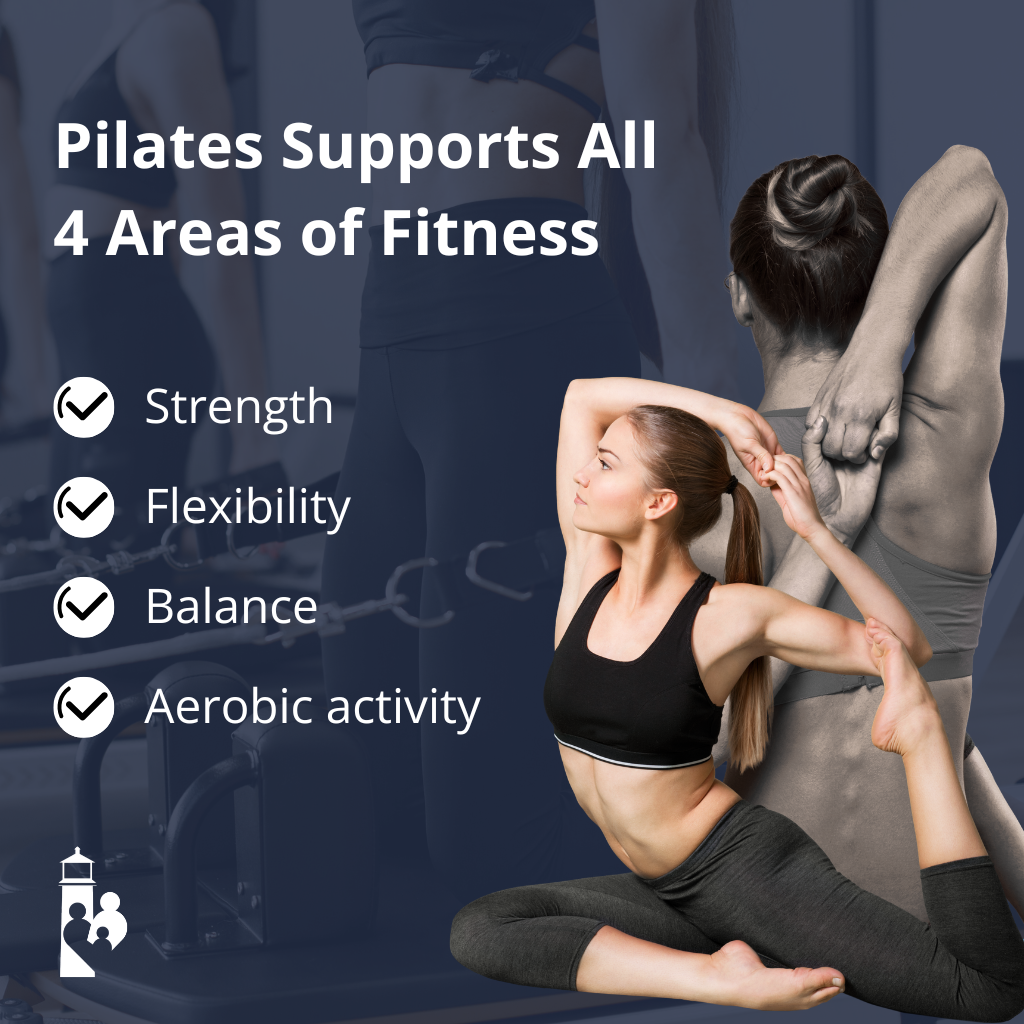
Pilates supports that end in a unique and complete way by targeting all four areas of physical fitness: strength, flexibility, balance, and aerobic activity. And it does so without putting excessive force on your joints, which means you can keep doing it without sidelining yourself with injuries. For anyone who struggles with balance or fall risk, Pilates can be especially valuable for that reason.
Consistency: The Key to All Exercise
To see the benefits of Pilates, or any form of exercise, the most important factor isn’t how long you work out or how difficult the regimen is. It’s consistency.
That may sound simple, but I think our experience would suggest that consistency is a real challenge for most of us. Life gets in the way. Work stress, family obligations, travel, and unexpected emergencies interrupt our routine.
The problem isn’t truly the interruptions. It’s beating ourselves up for missing a day, getting discouraged, and not picking back up where we left off. Interruptions are inevitable. That’s fine. What’s not fine is letting those interruptions become the new normal.
Over the past 15 months, I’ve averaged about 2.7 sessions per week against a goal of three. That means I’ve missed roughly 10% of the sessions I intended to do. Should I beat myself up about it? No. The truth is that a 10% failure rate doesn’t hinder progress. However, a 50% failure rate would mean I’m fooling myself.
The target I give patients for weekly exercise is a minimum of 150 minutes. That might look like 20 to 30 minutes every day, or three sessions of 45 to 50 minutes per week. It’s not an overwhelming amount, but it is a real commitment.
Remember, we lose muscle mass every year after our mid-20s. The rate accelerates in our 50s and 60s, and again after 70. With that muscle loss comes reduced balance, increased injury risk, and a lower quality of life overall. So the best time to start building a solid foundation for your future is today.
How Late Is Too Late? Pilates for Older Adults
Because I’m not overweight and I appear reasonably fit, most people have always assumed I exercise regularly.
But I didn’t. Not consistently. It wasn’t until I was 62 that I committed to regular exercise, and the reason was simple: I did the math. If I wanted to be skiing at 80, I needed to start building toward that right now.
But what if you’re already 80? Is it too late?
No. There is no age at which it’s too late to start moving your body.
You may not make it out to the ski slopes if you’re starting from zero at 80. But you can absolutely reduce your risk of falling. You can make daily activities easier. You can feel more like an active, capable part of your community.
Whatever degree of movement is available to you, use it. It matters. Even for patients in the hospital after a surgery, one of the first things we do is bring in physical therapy to keep them moving. That’s how important it is.
If you have to start with five minutes a day, start with five minutes. After a few weeks, you’ll naturally find yourself doing more. Don’t think of it as a program you have to maintain. Think of it the way you think about sleeping and eating; you don’t skip those one day and do them the next. They’re daily necessities. Exercise belongs in the same category.
Benefits of Pilates: Final Thoughts
I’ve never been someone who enjoys exercise for its own sake. I’m happy to be honest about that.
But the benefits of Pilates have shown up in my life in ways that are practical, measurable, and motivating: stronger legs on the ski slopes, a more resilient elbow on the tennis court, and the confidence that I’m building toward the life I want at 80.
I’m even starting to enjoy my sessions. And when I miss one, I notice it.
If you’re looking for a place to start, you might consider Pilates, or you can find another activity that better suits your personality and lifestyle. The important thing is to choose a program you’ll actually stick with.
Let your goals drive your choices. Once you find something that works, schedule it like any other necessity and let consistency do its job.